
A powerful 7.8-magnitude earthquake struck off the coast of Mindanao in the Philippines on Monday morning, killing at least 15 people and causing widespread damage to buildings. The quake also triggered tsunami warnings in several Asian countries.
According to the United States Geological Survey, the earthquake occurred shortly before 7:40 a.m. local time and was followed by numerous aftershocks. The Philippine Institute of Volcanology and Seismology described the shaking in General Santos City as “very strong.”
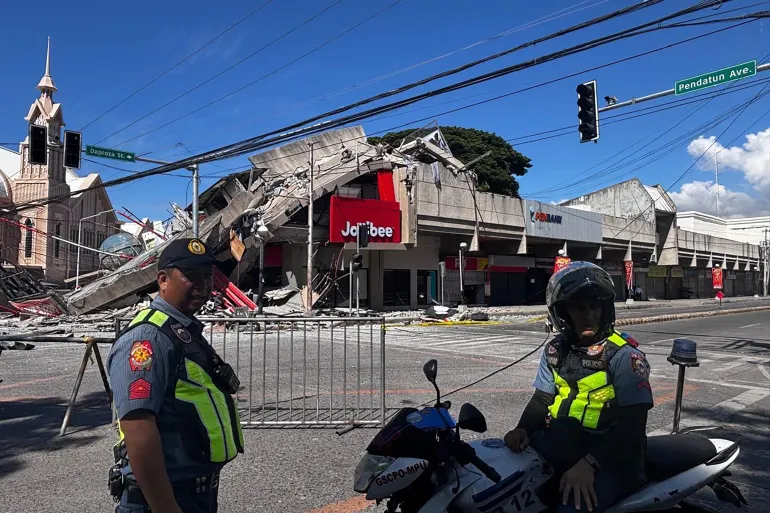
General Santos, home to more than 700,000 people, suffered some of the worst damage. A three-storey building that housed a Jollibee restaurant collapsed, while several other buildings experienced broken windows, damaged roofs and structural destruction.
Parts of St. Elizabeth Hospital were also badly damaged, forcing patients and medical staff to evacuate and continue operations outside the main building.
Philippine President Ferdinand Marcos Jr. activated emergency response agencies and ordered the closure of schools in affected areas. More than 3.2 million students and 128,000 teachers and school personnel were impacted on what was supposed to be the first day of the school year.
Authorities issued tsunami warnings for several coastal provinces, urging residents to move to higher ground and advising boat owners to secure their vessels and stay away from the shoreline.
The Pacific Tsunami Warning Center initially warned that waves of up to 3 metres could reach parts of the Philippines, while smaller waves were possible in Indonesia and Malaysia. Later, the centre announced that the major tsunami threat had passed but advised coastal communities to remain alert and follow official instructions.
The highest tsunami wave recorded was 0.83 metres in Indonesia’s Northern Sulawesi province.